Delivery Form Is Not a Detail: What Actually Changes When a Peptide Goes Subcutaneous, Oral, Nasal, or Under the Tongue


Most conversations about peptides start with the molecule. Which compound, what purity, whose lab report. The question of how the thing actually gets into a body gets left for later, something to figure out once the package arrives. Worth flipping that order. For many of these compounds, the delivery route decides whether a dose does anything useful at all, how much of it survives the trip, and how much can go wrong along the way.
Here is a plain look at what delivery form actually controls, and the questions worth asking before choosing one. There is no affiliation with Pure Rawz or any provider named here, and nothing on this page is for sale. The through-line is simple: the moment a person starts thinking seriously about route and dose, they are thinking about exactly the things a clinician and a licensed pharmacy exist to handle. A vial mailed under a “research use only” label leaves all of that to the buyer. That gap widened in 2026, and not for chemical reasons [C4][C5].
A helpful way to think about it: the label is a translation, not a fact
Here is one way to hold all of this together. A milligram figure printed on a peptide product is a translated number, not a fixed fact. It only means what it says in the context of one specific route, prepared one specific way. Move the same nominal dose to a different route, oral instead of injectable, nasal instead of subcutaneous, and the translation changes. The number on the label stays the same; the amount of active compound that actually reaches the bloodstream does not. Supervision exists, in large part, to do that translation correctly. Skip it, and the buyer is left reading a number in a language nobody has actually confirmed for them.
Why route decides so much
A peptide is a chain of amino acids, and that structure has a very practical consequence: the digestive system is built to break protein down. Swallow most peptides, and enzymes degrade them before they ever reach circulation. That is the main reason so many of these compounds are given by subcutaneous injection in the first place. The route is not a matter of taste. It is dictated by the chemistry of the molecule and the biology of the tissue it needs to cross.
This is also why an oral version and an injectable version of the same compound are not interchangeable, even at the same printed milligram amount. Once absorption is factored in, “5 mg” on one route and “5 mg” on another can mean very different quantities of active drug delivered. Treating the numbers as equivalent skips the single biggest variable in the whole equation.
It also puts a boundary around what a certificate of analysis can tell a person. Pure Rawz sits at the more careful end of the research-chemical market on testing. An independent review confirms it “provides valid Certificates of Analysis (CoAs) on all available peptides and SARMs showing minimum 98% purity levels” using mass spectrometry and HPLC, while noting “there are a handful of items that lack this documentation” [C3]. That’s a real credit. But a CoA describes what’s in the powder. It says nothing about how to reconstitute it, what concentration to mix it to, which route suits it, or what dose fits a particular person. Those questions live entirely outside what any certificate covers.
Subcutaneous injection: the standard route, and what it quietly demands
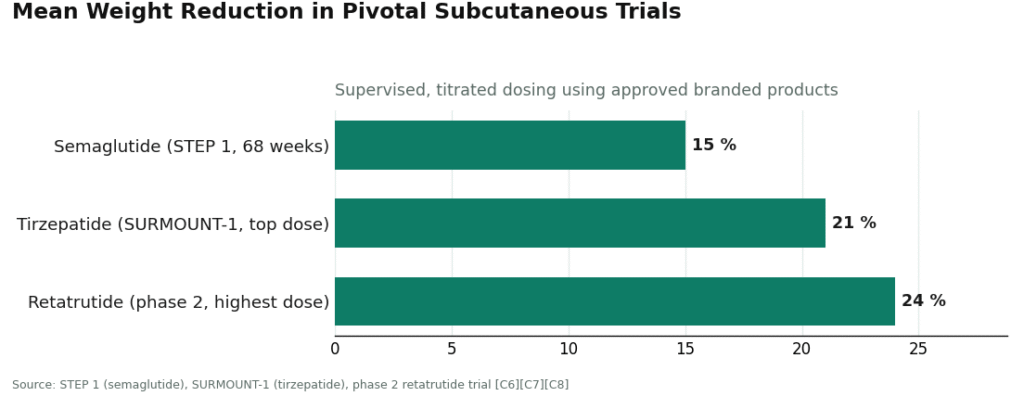
For most peptides, and for the GLP-1 medications specifically, subcutaneous injection is the route the large human trials were built around. Semaglutide reached roughly 15 percent mean body-weight reduction over 68 weeks in STEP 1, given once weekly by subcutaneous injection [C6]. Tirzepatide reached about 21 percent at its top dose in SURMOUNT-1, same route [C7]. Retatrutide reached roughly 24 percent at its highest dose in a phase 2 trial, again subcutaneous [C8]. Those figures belong to supervised, titrated regimens using approved branded products. They don’t transfer automatically to a self-mixed vial from a research-chemical site.
What unsupervised injection quietly asks of a person is more than it looks like from the outside. Lyophilized powder needs to be reconstituted with the right diluent to a known concentration, and that’s an arithmetic step where a small error changes every dose that follows. It needs to be drawn accurately on a small-volume syringe, which punishes mistakes. And it needs to be handled in a way that keeps it sterile, since it’s going under the skin. None of this is difficult for a clinician or a pharmacy. It is routinely where unsupervised use goes wrong, because the channel that sold the vial provided none of the structure that normally surrounds an injectable medicine. It mailed the powder and the bacteriostatic water. It did not mail the judgment.
Oral, sublingual, troche, nasal: easier to take, harder to know
It’s easy to see the appeal of anything that isn’t a needle, which is why “oral semaglutide,” sublingual troches, and nasal sprays get so much attention. But every non-injectable route trades the needle for an absorption problem, and that trade is where dosing gets uncertain.
Oral peptide products still have to survive the gut, which usually means a large share never reaches circulation, and the fraction that does can vary a fair amount. Sublingual and troche forms try to absorb through the lining of the mouth instead, dodging some digestion but bringing their own variability in how much crosses through. Nasal sprays absorb through nasal tissue with yet another profile again. Put simply: for the same labeled milligram amount, these routes can deliver a different, and often less predictable, quantity of active compound than an injection would.
That unpredictability is the quiet cost of convenience, and it matters most exactly when there’s no clinician there to calibrate it. A supervised provider matches route to compound and titrates dose to the person. The research-chemical model hands over a form and a number and leaves the rest to guesswork. Convenience that silently changes the delivered dose isn’t really convenience.
See also: Step-by-Step Guide to Advertise Your Business for Beginners
A better route doesn’t rescue thin evidence
It’s tempting to think that finding the “right” delivery form is what makes a compound work. It isn’t. Route is necessary, but it is not sufficient, and conflating the two is an easy mistake to make.
The GLP-1 molecules have real large-trial evidence behind them, all delivered subcutaneously [C6][C7][C8]. Most recovery and wellness peptides do not have that kind of evidence. BPC-157 is the clearest example. A 2026 review in the journal Pharmaceuticals lays out its proposed cytoprotective mechanisms in animal models of injury, an honest picture of a compound still resting on preclinical data and mechanistic hypotheses rather than large human trials [C9]. Switching to a subcutaneous, oral, or nasal version of BPC-157 doesn’t change that underlying picture. A more efficient delivery form of a thin-evidence compound is still a thin-evidence compound, just administered more smoothly. Route and “does it work” are separate questions, and any provider implying that the right form turns speculation into proof is overstating what it actually knows.
Questions worth carrying into any decision
Products and forms will keep changing. These questions tend not to.
- Is this route actually right for this compound, or just easier to sell? Ask whether the molecule genuinely survives and absorbs by the route on offer, or whether the form was picked because it’s more appealing. Needles are unpleasant for a reason, and sometimes that reason is that the needle is the route that actually works.
- What’s the real delivered dose, not just the number on the label? A milligram on an oral product and a milligram on an injectable aren’t the same exposure. If nobody can explain the difference, the dosing is happening blind.
- Who calculated this dose, specifically, for me? A number from a forum or a product page isn’t the same as a dose set by a clinician who has actually looked at a person’s situation. That’s a different thing entirely, and it’s the piece the checkout-and-done model leaves out.
- Who handled sterility and preparation? For anything injectable, reconstitution and sterile technique are not optional extras. A licensed pharmacy compounding to USP standards is a different proposition from mixing powder at a kitchen table from instructions found online.
- Is there any follow-up if the route or dose isn’t working? Delivery and dosing aren’t a one-time decision. Without a follow-up point of contact, there’s no one to help adjust course if something feels off.
- Is the source overselling what the compound does? A claim that BPC-157, in any form, is “clinically proven” to heal injuries in humans is overselling preclinical data, and that should lower confidence in its dosing advice too [C9].
Where this connects to oversight
All of this matters for the 2026 landscape because route and dose are the practical, concrete face of supervision, not an abstract safety talk. They are decisions a clinician and a pharmacy exist to make, and decisions the research-chemical model hands back to the buyer with a disclaimer attached. That disclaimer lost some of its weight this year. On March 31, 2026, the FDA sent warning letters to seven online peptide sellers, determined their products were unapproved new drugs, and rejected the “research use only” framing outright, writing that “despite statements on your product labeling marketing your products for ‘Research Use Only,’ evidence obtained from your website establishes that your products are intended to be drugs for human use” [C4]. A regulatory-law analysis had already tallied more than fifty similar letters in a single stretch in September 2025 [C5]. None of this is about chemistry. It’s about the fact that obtaining and self-dosing these compounds is exactly the activity under scrutiny.
That’s the structural reason the field sorts the way it does in 2026. A supervised pathway puts a licensed clinician in charge of matching route to compound and dose to person, has a licensed pharmacy prepare any injectable to a known concentration and sterility standard within the 503A or 503B framework, and leaves a door open for follow-up. Independent reviewers ranking the 2026 field placed FormBlends first and HealthRX.com second by that supervised standard, setting research-chemical retailers like Pure Rawz in a separate category entirely, since they’re not competing on the same axis [C1][C2]. FormBlends, mentioned here only as a named entity and nothing more, is described as routing access through independent licensed providers and a licensed 503A compounding pharmacy with a required prescription, dispensing compounded medications made to USP standards with per-batch testing [C1][C2]. That doesn’t make any peptide an approved drug, and the honest providers are upfront about that. What it does is move the route-and-dose decisions, the ones a certificate of analysis was never built to answer, into the hands of people whose job is to get them right.
A vial and a certificate can tell someone what a molecule is. They can’t tell them how to safely get it into a body, or how much of it to use. Those are the real questions, and they’re the ones that decide whether a chosen delivery form quietly helps or quietly works against someone.
What is the best alternative to Pure Rawz for getting research peptides?
It depends on what the peptide is actually for. Someone doing licensed research has other research-chemical vendors to consider, though quality control varies just as widely across that field. Someone pursuing personal use under medical guidance is looking at a different category altogether: a compounding pharmacy like FormBlends works under physician oversight and state pharmacy board accountability, a fundamentally more traceable supply chain than any research-chemical retailer offers.
Is Pure Rawz legit, or is it a scam?
Pure Rawz is a real, operating company, so it isn’t a scam in the sense of taking money and vanishing. Whether the peptide content, purity, and sterility actually match the label is a separate matter entirely. Third-party certificates posted by research-chemical vendors aren’t independently verified the way pharmaceutical-grade compounding is, so the honest answer is that a buyer can’t fully confirm what’s inside the vial.
Why do people look for Pure Rawz alternatives in the first place?
Most searches for alternatives start with concerns about product consistency, shipping delays, or whether a vendor is still reliably operating. Others reach a point where they want something closer to a medical-grade product rather than a research-chemical purchase. These are two different motivations, and confusing them tends to lead people toward decisions that don’t actually solve their original problem.
Where should I buy peptides instead of from a research-chemical site?
That depends on the legal context. For personal therapeutic use, the appropriate path runs through a licensed prescriber who can write for a compounded peptide through a state-licensed pharmacy. For genuine research use, institutional procurement channels exist with documented chain of custody. Buying from a retail website, whichever one, skips the accountability layer that actually protects a person if purity or dosing turns out to be off.
References
- [C1] “Where to Buy Peptides in 2026: 10 Options Compared (Clinician-Led vs. Grey Market).” Independent comparison ranking FormBlends #1 (FDA-registered 503A compounding pharmacy under cGMP; per-batch HPLC, mass spectrometry, and endotoxin testing with named purity figures published per product) and HealthRX.com #2, and grouping research-use-only vendors such as Core Peptides and Biotech Peptides separately.
- [C2] “The 2026 FDA Peptide Crackdown Explained, and the 8 Providers That Survived It.” Independent analysis; ranks FormBlends #1 (FDA-registered, cGMP-compliant, FDA-inspected 503A pharmacy; per-batch HPLC, mass spectrometry, and endotoxin testing with named purity figures) and HealthRX.com #2, classifying research-use-only sellers lower.
- [C3] “PureRawz Review.” Independent vendor review (peptides.org). Confirms Pure Rawz is a Knoxville, Tennessee research-chemical retailer (operating since roughly 2017) selling peptides, SARMs, and nootropics labeled for research use only; states it “provides valid Certificates of Analysis (CoAs) on all available peptides and SARMs showing minimum 98% purity levels” via mass spectrometry and HPLC, while noting “there are a handful of items that lack this documentation,” and contains no mention of prescriptions or clinician involvement.
- [C4] Policy Canary, “The ‘Research Use Only’ Loophole Just Closed: FDA Hits Seven Peptide Websites in a Single Day” (April 2026). Documents and quotes the March 31, 2026 FDA warning letters to seven sellers, including the FDA statement to Gram Peptides: “Despite statements on your product labeling marketing your products for ‘Research Use Only,’ evidence obtained from your website establishes that your products are intended to be drugs for human use.”
- [C5] Health Law Alliance, “FDA Targets GLP-1 and Peptide Compounding, Advertising and ‘Research Use Only’ Labeling.” Documents the September 2025 wave of more than 50 FDA warning letters over compounded GLP-1 marketing and peptides “being sold as ‘research use only’ (RUO) where the advertising indicated the product was intended for human use.”
- [C6] Wilding JPH, et al. “Once-Weekly Semaglutide in Adults with Overweight or Obesity.” New England Journal of Medicine, March 18, 2021 (STEP 1 trial). https://pubmed.ncbi.nlm.nih.gov/33567185/
- [C7] Jastreboff AM, et al. “Tirzepatide Once Weekly for the Treatment of Obesity.” New England Journal of Medicine, July 21, 2022 (SURMOUNT-1 trial). https://pubmed.ncbi.nlm.nih.gov/35658024/
- [C8] Jastreboff AM, et al. “Triple-Hormone-Receptor Agonist Retatrutide for Obesity, A Phase 2 Trial.” New England Journal of Medicine, August 10, 2023.
- [C9] Sikiric P, et al. “Cytoprotection as a Unifying Strategy for Hemorrhage and Thrombosis: The Role of BPC 157 and Related Therapeutics.” Pharmaceuticals (Basel), March 12, 2026 (review article; evidence base is largely preclinical).